Consumptive Use Mitigation Grant 2026 Awardees
This grant program aims to fund projects that mitigate consumptive use or otherwise improve drought resilience in the Susquehanna River Basin.
The Consumptive Use Mitigation Grant Program addresses the need for water availability and watershed resilience work throughout the basin and provides financial support to bring projects to life. More information on the Consumptive Use Mitigation Grant Program is available here.
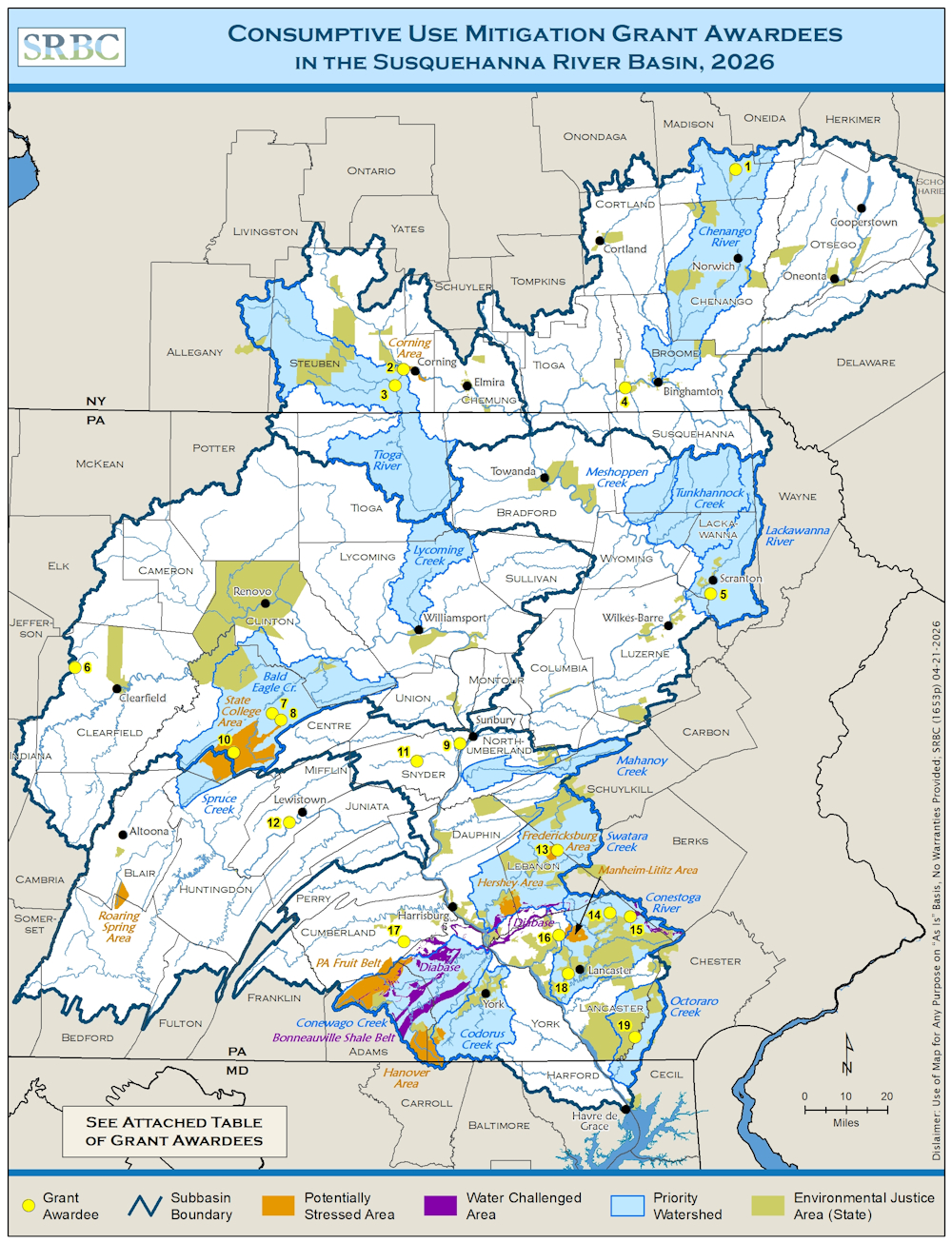
- New York Power Authority (NYPA)
- Town of Erwin
- NYS Office of Parks, Recreation and Historic Preservation
- Town of Vestal Water Department
- Glenmaura National Golf Club
- City of DuBois
- Heidelberg Materials Northeast LLC
- Walker Township Water Association
- Susquehanna Valley Country Club
- Spring Creek Watershed Commission
- Middleburg Area Recreation Association
- Lewistown Country Club
- Byler Golf Management, Inc. dba Blue Mountain Golf Course
- Lancaster Farmland Trust
- Adamstown Borough
- Manheim Area Water and Sewer Authority
- Cumberland County
- Conestoga Country Club
- Chester Water Authority
(See map for project locations)
The New York Power Authority will use grant funds to support the rehabilitation of the low-level outlet infrastructure at the Madison Reservoir Dam in Madison County, NY. This includes the installation of new outlet pipes, valves, controls, and inlet and outlet structures to promote dam resilience and reliability. This project will enhance the ability to manage water supply storage that can be used to offset or mitigate the impact of downstream consumptive use, as well as improve reservoir releases to support drought resilience during low flow periods. For additional information, please visit: Madison Reservoir Dam Rehabilitation Project. This project is located within a Commission identified consumptive use priority area.
The Town of Erwin, located in Steuben County, NY, will use grant funds to purchase and install 4 iHydrants within their municipal water distribution system to identify leaks and proactively reduce water loss. The iHydrants allow for early detection of leaks so that the Town can prioritize repairs and reduce the volume of water loss due to undetected leaks. The new hydrants could result in water savings of up to 7.6 million gallons annually, helping to promote drought resilience within the basin. The Town of Erwin is located in a Commission identified potentially stressed and consumptive use priority area.
The New York State Office of Parks, Recreation, and Historic Preservation will use grant funds to replace the existing irrigation system at Indian Hills Golf Course, located in Steuben County, NY. This includes the installation of a new pump station and distribution network that will increase irrigation precision and limit unnecessary consumptive use. Additionally, modifications to the irrigation pond will be made to increase storage capacity by approximately 8 acre-feet and improve water level management. The dimensions of fairways, tees, and greens will be decreased, lessening the area that has been historically mowed and irrigated and thus reducing the quantity of water used for irrigation. This project is located within a Commission identified consumptive use priority area.
The Town of Vestal Water Department, located in Broome County, NY, will use grant funds to purchase and install leak detection equipment to allow for timely identification and repair of leaks. Updates to the system are expected to result in a loss reduction of 18,132,732 gallons annually. This project will mitigate consumptive use by reducing the volume of water the system must withdraw in order to meet demands.
Glenmaura National Golf Club, located in Lackawanna County, PA, will use grant funds for Phase II of an ongoing drought resilience project. Phase II of the project includes reconstructing greens to reduce irrigation demand, thus reducing withdrawals for consumptive use. Reconstruction of the greens and turf conversion is expected to result in an irrigation demand reduction of approximately 3.8 million gallons per year. This project is located within a Commission identified consumptive use priority area.
The City of DuBois will use grant funds to preserve existing water supply storage by replacing an inoperable discharge valve at the Anderson Creek Dam in Clearfield County, PA. Replacing the valve will conserve water supply that may otherwise be lost via leakage. This will also allow for improved controllability of reservoir releases, increasing the resiliency of the water supply. This project is expected to eliminate the loss of 2 million gallons of water per day.
Heidelberg Materials Northeast LLC will use grant funds to increase the size of the pit sump at Curtin Gap Quarry, located in Centre County, PA. The proposed sump will hold approximately 50 million gallons of water. This additional storage will allow the quarry to discharge enough water to sustain flow in Nittany Creek during low flow periods. Additionally, a dedicated variable frequency drive (VFD) pump will be purchased so that discharge rates can be varied to accommodate streamflow conditions. This project is located within a Commission identified consumptive use priority area.
Walker Township Water Association, serving three municipalities within Centre County, PA, will use grant funds to purchase upgraded leak detection equipment to proactively identify and address water loss within the distribution system. Through the reduction in water loss via identification and timely repair of leaks, the project will lessen withdrawals and offset consumptive use. The project is estimated to result in a loss reduction of 34,500 gallons per day. This project is located within a Commission identified consumptive use priority area.
Susquehanna Valley Country Club, located in Snyder County, PA, will use grant funds to make upgrades to the existing irrigation system that will reduce over-watering and thereby reduce consumptive use. Additionally, sediment will be dredged from two existing irrigation ponds and pond conveyance structures will be repaired or replaced to decrease pond leakage and increase usable storage for irrigation. Irrigation repairs are estimated to result in 1.95 million gallons per year in water savings, and pond repairs are expected to prevent the loss of approximately 25 million gallons of water storage.
The Spring Creek Watershed Commission will use grant funds for a regenerative stormwater management project at Tom Tudek Memorial Park, located in Centre County, PA. The project includes the installation of rock cross vane structures on an Unnamed Tributary to Big Hollow to reconnect the stream channel to the floodplain via step-pool conveyance, decreasing stream velocity and increasing groundwater recharge. It is estimated that this project could result in 3 million gallons of groundwater recharge annually, supporting groundwater resources and critical baseflow during periods of low flow. This project is located within the Spring Creek Watershed, a Commission identified potentially stressed and consumptive use priority area.
The Middleburg Area Recreation Association will use grant funds for irrigation system upgrades and turf to meadow conversion at Shade Mountain Golf Course in Snyder County, PA. Upgrades to the existing irrigation system will improve irrigation efficiency, resulting in reduced withdrawals for consumptive use and saving an estimated 6,750,000 gallons of water per year. Additionally, 4 acres of turfgrass will be converted to native meadow area, reducing irrigation needs, promoting increased groundwater recharge, and thereby improving drought resilience in the basin.
Lewistown Country Club, located in Mifflin County, PA, will use grant funds to implement Phase III of an ongoing irrigation system replacement project. This will include the installation of new irrigation equipment to optimize irrigation efficiency and reduce water withdrawn for consumptive use by an estimated 1 million gallons annually. Additionally, Phase III includes turf to meadow conversion and stormwater BMP installation funded by PADEP’s Mifflin County CAP Block Grant Program.
Blue Mountain Golf Course, located in Lebanon County, PA, will use grant funds to reduce consumptive use by modernizing the existing pumphouse, upgrading existing irrigation infrastructure, and increasing storage capacity of the existing irrigation pond. New pumps and irrigation equipment will allow for more precise irrigation, limiting unnecessary over-watering, saving an estimated 500,000 gallons of water annually. Additionally, improvements to the existing storage pond will increase storage by 2.3 million gallons. This project is located within a Commission identified consumptive use priority area.
Protecting Water and Soil in Lancaster County’s Conestoga Watershed: The Revised Weaver Farm Project
The Lancaster Farmland Trust will use grant funds to permanently preserve an 88-acre farm through a conservation easement in Lancaster County, PA. The southern 54 acres of the farm are within Commission identified Highest Groundwater Recharge Potential areas. Additionally, stormwater and agricultural BMPs will be implemented to support water quality improvements in a region with impaired water quality due to significant agricultural land use. This project is estimated to result in approximately 33 million gallons per year of groundwater recharge within the Conestoga River Watershed, a Commission identified consumptive use priority area.
Adamstown Borough, located in Lancaster County, PA, will use grant funds to purchase and install upgraded metering infrastructure to reduce system water loss. The upgraded equipment will allow for timely leak detection and repairs. These improvements are expected to reduce system water loss from 27% to an estimated 10%, amounting to approximately 8.9 million gallons saved annually. Adamstown Borough is located within the Conestoga River Watershed, a Commission identified consumptive use priority area.
Manheim Area Water and Sewer Authority, serving three municipalities within Lancaster County, PA, will use grant funds to install meters to enable rapid leak detection and reduce system water loss. The Authority estimates that this project could eliminate 21,435,416 gallons per year of uncontrolled water loss. This loss reduction would result in a decreased need for withdrawals for consumptive use. This project is located within a Commission identified potentially stressed area.
Cumberland County will use grant funds to acquire an agricultural conservation easement on a 132-acre farm in Monroe Township, PA. Nearly 70% of the farm is designated as having high or above average potential for groundwater recharge, based on SRBC Groundwater Recharge Potential Mapping. Preservation of the farm is expected to result in an estimated 61,650,441 gallons of recharge annually. Cumberland County is one of the fastest growing counties in PA, making preservation of high recharge areas a fundamental part of conserving water resources within the basin.
Conestoga Country Club, located in Lancaster County, PA, will use grant funds to reduce consumptive use by upgrading existing irrigation infrastructure, and increase groundwater recharge by reducing the amount of turf area and incorporating approximately 17 acres of meadow and naturalized grass areas. Irrigation upgrades are estimated to result in 40,000 gallons per day of water saved, with additional water savings resulting from increased infiltration in naturalized areas. Additionally, water quality benefits will result from a 4 acre expansion of riparian areas along the Little Conestoga Creek, a Commission identified consumptive use priority area.
The Chester Water Authority, serving Lancaster, Chester, and Delaware counties, will use grant funds to enhance the reliability and usability of existing water storage at the Octoraro Reservoir by installing aeration units on each tributary feeding the reservoir. This will improve dissolved oxygen levels, reduce thermal and chemical stratification, and prevent anaerobic conditions, allowing Chester Water Authority to meet water demands using the existing water supply. By improving the usability of existing water storage, this project will result in a reduced likelihood of increased withdrawals for consumptive use during low-flow periods, promoting drought resilience. This project is located within a Commission identified consumptive use priority area.